Showing posts with label local produce. Show all posts

Friday, June 25, 2010

Anti-Inflammatory Diet = Good Summer Eating

Recent health journals have been reporting that lowering cellular inflammation in the body reduces the risk of chronic diseases such as heart disease and diabetes, as well as facilitating weight loss, reducing depression, acne, aging, arthritis, Crohn’s disease and multiple sclerosis. Drs. Barry Sears (Zone Diet), Nicholas Perricone (weight loss and cosmetic guru) and Andrew Weil (natural health and healthy aging proponent) have written books and listed anti-inflammatory diets on their websites over the last ten years. Several new books have also been released on this topic.

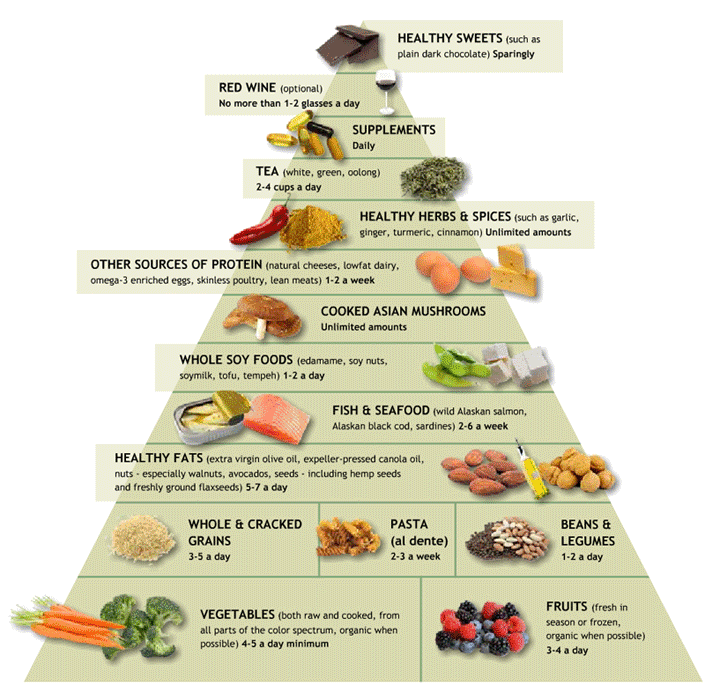
While the content of this diet differs somewhat by creator, included in all diets are colorful fruits and vegetables, especially berries. Dr. Weil’s Anti-Inflammatory Food Pyramid lists 3-4 servings of fruit and 4-5 servings of vegetables as the base of this diet (a serving equals ½ cup cooked or chopped fruit or vegetable, 2 cups of leafy greens or 1 piece of fruit). Fruits and vegetables contain powerful antioxidants that protect the body against disease, especially cancer.

All diets emphasis choosing healthy fats, focusing on monounsaturated fats found in olive oil, nuts, avocados and fatty fish like salmon and sardines. Fish oil supplements are another method to boost omega-three fatty acid intake, also linked to reduced chronic disease risk. Plant sources of omega-3 fatty acids are walnuts and flax (now added to some cereals, bread and granola bars).

Healthy carbohydrates can include whole grain breads, legumes and fruits and vegetables. Many healthy carbs contain fiber and have a lower glycemic index(slowing the spike in blood sugar created when eatingf ood made from refined flour and sugar), both linked to lower inflammation.

The anit-inflammatory diet advises to avoid processed foods as much as possible. Some health educators recommend basing food choices on the number of ingredients listed on the package food label. Processed foods often contain multiple preservatives and ingredient derivatives. Be cautious, however, of food spoilage and mold if unprocessed food is purchased. Tea, both black and green, contains antioxidants linked to reduced chronic disease. Red wine and dark chocolate, eaten in moderation, are also foods found on the Mediterranean diet and Dr. Weil’s anti-inflammatory food pyramid.

Finally, spices such as turmeric, ginger, green onions and garlic have found their place on these diets. Flavoring your food with these antioxidant spices and herbs instead of salt has long been a recommendation for lowering blood pressure and reducing the risk of heart disease and stroke. The anti-inflammation diet recommendations fit well with the abundance of colorful summer vegetables and fruits into our markets. Enjoy the dark greens, blue and blackberries,summer squash and tomatoes, seasoned with a little olive oil and vinegar and topped with toasted sunflower seeds. Add some fresh brewed ice tea - either black or green - and you'll be eating healthy this summer.
http://www.drweil.com/drw/u/PAG00361/anti-inflammatory-food-pyramid.html Pyramid shown is the Anti-inflammatory Food Pyramid from Dr.Weil.

Friday, May 21, 2010

Enjoy Your Local Farmers' Market

Shopping at a farmers market can be fun, and also good for you and your community. Some of the many reasons for shopping at a farmers’ market include. The freshest foods are available. You can meet the farmer who grew your food. You can save money, especially on organic produce. Farmers markets also provide a livelihood for many farmers who might not be farming without the market opportunity.

Enjoy your time at the market. Take time to browse before buying. Take time also to compare the offerings of different vendors. Try new foods. Buy something you’ve never had before. Ask the farmer the best way to enjoy it. Never cook kohlrabi? At the farmers market, a grower can probably tell you how to select and prepare it. Chat with the farmers. Getting to know the local growers or farmers is part of the fun of shopping at farmers markets. You’ll become a wiser shopper.

After shopping go straight home. Plan to bring your purchases home before running any more errands. If you leave fresh produce sitting in a hot car it can wilt.

Farmers’ markets have different days and hours of operation so check that your local market is open before you leave home to shop. Here a few additional tips for shopping at a farmers’ market.

Bring your own bag. Bring a basket or a light shopping cart. Recycle plastic bags, by bringing them with you and asking the farmers to use them instead of theirs. Keep an inexpensive cooler in your car to keep produce fresh and safe during hot weather.

Shop early. You’ll find the best selection early in the day, so try to get there when the market first opens.

Go without a firm list. This probably goes against what you’ve learned in the past, but the point of going to the farmers’ market is to get the freshest possible produce. So plan on buying whatever looks best and plan your meals around your purchase.

Monday, June 29, 2009

Strawberries! Not Just for Dessert Anymore

Okay, there is nothing better than picking fresh berries off the vine. Strawberries are mainly thought of as an ingredient in desserts. In many dessert recipes strawberries seem to be associated with high fat, high calories ingredients. But no more, strawberries have evolved into many other uses in our daily menu. The reason why strawberries should be a common choice ingredient in our diets is that it is low in calories and has its own a distinct natural sweet taste. For lunch strawberries may either be served along with other fruits, as an appetizer, or with garden greens to complete a vegetable salad. But did you know that strawberries also make good ingredients for main dishes? There are recipes where strawberries are added to braised or grilled chicken. They can also be pureed into a sauce for meat dishes or served as dip with seafood.

Nutritional Powerhouse:

These little heart shape fruit pack some nutritional punch to protect your heart, increase HDL (good) cholesterol, lower your blood pressure, and guard against cancer. Packed with vitamins, fiber, and are a good source of manganese and potassium. They are also in the top 20 list for fruits with antioxidant known as polyphenols. One serving (about eight strawberries) provides more vitamin C than an orange and is approximately only 55 calories. Naturally sweet strawberries are a fat-free, cholesterol-free, and sodium-free food. Strawberries are a favorite food choice for individuals watching their weight, due to their health benefits.

Choose medium-sized berries that are firm, plump, and deep red; remember once picked, they won't ripen further. Avoid berries that are wrinkled, soft, spotted with mold or leaking juice. Use any over ripe berries within 24 hours of purchasing and wash before eating to remove any loose soil, but do not wash before storing in the refrigerator this promotes the growth of mold.

Fun Strawberry Facts

Strawberries are the first fruit to ripen in the spring.

  • Strawberries are a member of the rose family.
  • The flavor of a strawberry is influenced by weather, and stage of ripeness when harvested.
  • On average, there are 200 seeds in one strawberry.
  • The strawberry is the only fruit with the seeds on the outside of the fruit.
  • Americans eat 3.4 pounds of fresh strawberries each year plus another 1.8 pounds frozen per capita. Although strawberries are available in many forms—frozen, jam and jelly, and ice cream— nothing compares to the taste of a fresh vine ripened strawberry.

Here is a great recipe to add strawberries to your lunch or side salad for dinner.

SPINACH, STRAWBERRY, PECAN SALAD

1 lb. fresh spinach, washed & dried 1 pt. strawberries, washed & halved 1/2 c. pecan halves, toasted

DRESSING:

1/3 c. raspberry vinegar 1 tsp. dry mustard 1 tsp. salt 1/2 c. sugar 1 c. vegetable or olive oil 1 1/2 tbsp. poppy seeds

Combine dressing ingredients except the poppy seeds in a blender. Add the poppy seeds by hand. Toss dressing with spinach, strawberries and hot pecans. The hot nuts will slightly wilt the greens

So consider adding this seasonally available fruit to other parts of your diet, not just dessert. To purchase strawberries, check out local farmers market or pick-your-own farms in your local community and get that fresh picked taste. Enjoy the natural sweetness!

Thursday, May 7, 2009

Save the Day with Spinach!

As a child I watched Popeye the Sailorman cartoons on TV. When Popeye was in trouble he ate a can of spinach, his muscles would bulge and he would rush in to save the day. "Yeah right," I would think. "Spinach is gross!" As an adult, I now know that Popeye was a pretty smart guy, and I have learned to love spinach!

Easy to grow and now is the time. I can't remember how old I was when I started eating spinach, but I do remember that eating it fresh from the garden was what changed "Gross!" into "Yum!". Spinach is one of the easier vegetables to grow and spring is the time to plant. Check with your local State Cooperative Extension office for local growing details and resources to help you get started. If you can't grow your own spinach, check out your local farmers market for this fresh picked, nutrient rich vegetable.

There's more to spinach than meets the eye. Federal labeling only requires nutritional information for the main nutrients of A, C, Calcium and Iron. Spinach has these and so much more! Spinach is an excellent source of vitamin K, vitamin A, manganese, folate, magnesium, iron, vitamin C, vitamin B2, calcium, potassium, and vitamin B6. It is a very good source of dietary fiber, copper, protein, phosphorus, zinc and vitamin E. And spinach is even a good source of omega-3 fatty acids, niacin and selenium.

Use spinach raw or cooked.

Spinach is great raw in salads and dips. Cooked, it can be added to eggs, soups, and casseroles or as a side dish for breakfast, lunch and dinner making it easy to consume 5-9 servings of vegetables a day. Maybe my kids will not agree with that statement, I have not totally won them over to the wonders of spinach, but they have eaten it more than they know. Spinach has a wonderful mild taste when picked early as small leaves and compliments many recipes, so I add it to my cooking when available. The basic guidelines for selecting, storing and using spinach can be found at: http://montgomery.extension.psu.edu/Nutrition/PBGweb.pdf

So eat your spinach and save the day!

Monday, September 29, 2008

Understanding Organic Food Labeling

While there is no research proving that organic foods are a more nutritious choice, the number of customers requesting organically grown foods in grocery stores and local markets has increased dramatically in the past few years. All 50 states have USDA-certified organic farmland, totaling more than 4 million acres of range, pasture and cropland. Walmart jumped into organic food marketing this year, taking organic foods from the domain of earth friendly foodies and farmers to mainstream America. Early organically marketed foods were fresh fruits and vegetables, Today, many packaged foods are also carrying organic labels which may be confusing to consumers. There are four categories of product composition of organic claims. These standards have been established and are regulated by USDA. If a product is sold, labeled or represented as “100 percent organic”, it must contain 100% organically produced ingredients. Products sold, labeled or represented as “organic” must contain not less than 95% organically produced raw or processed agricultural products. Any remaining product ingredients must be organically produced, unless not commercially available in organic form, or must be nonagricultural substances or non-organically produced agricultural products produced consistent with the National List. Products sold, labeled or represented as “made with organic ingredients” must contain at least 70% organically produced ingredients. If a product has less than 70% organically produced ingredients by weight or fluid volume, it may only identify the organic content of the product by identifying each organically produced ingredient and the percentage of the ingredient. There are no requirements for organic food to be grown locally. There is no definition for what local means. Farmers growing organically do not use synthetic fertilizers or pesticides. In some studies, pesticide levels in organic produce have been shown to be lower than conventionally grown. However, pesticides residues in conventionally grown foods were well below federal standards and thus are considered safe based on scientific studies. As organic foods become more common in food markets and prices closer to conventionally grown products, more consumers will choose organic foods. Expiration dates may need to be observed more closely as organic foods will not contain the preservatives in conventional foods. Eating organic is an alternative option that will continue to expand and as we look to more sustainable lifestyles, organic foods may be a choice you decide to adopt.

Monday, August 4, 2008

Tomato Tips

Nutrition Summer and fall find tomatoes from the garden and farm markets plentiful. Tomatoes are nutritious, providing a good source of Vitamin A, and an excellent source of Vitamin C and potassium. Tomatoes are also rich in lycopene, the antioxidant that is protective against cancer, particularly prostate cancer in men. Storage Store tomatoes at room temperature, out of direct sunlight. Unripe tomatoes can be placed in a paper bag to hasten ripening. At the end of the season, when frost is imminent, you can pick mature green tomatoes and store them for weeks in a dark, cool place. Place on a rack or individually wrapped in newspaper. Bring in to room temperature to ripen as needed. Preservation To further preserve tomatoes for future use, you can use a boiling water canner to process whole or halved tomatoes, tomato juice, salsa, plain tomato sauce or ketchup. Acidify with lemon juice or citric acid. For recipes that contain other vegetables, such as spaghetti sauce, a pressure canner must be used. Always use a standardized recipe from a reliable source and do not alter the ingredients. If the tomato product will be used in cooked form such as stews, soups or sauces, they can be frozen. Wash under cool running water, blot dry, and remove stem scar. To freeze with the skins on, place them on cookie sheets and freeze. Place into freezer bags or containers. To remove the skin, run warm water over the frozen tomato and the skin will slip right off. If you would prefer to remove the skins before freezing, blanch in boiling water for a minute until the skins split. Peel and freeze. Tomatoes can be frozen whole, chopped or pureed. Leave an inch of headspace for expansion in freezer container. Here is one of my favorite ways to use tomatoes and other late-summer vegetables. Spaghetti Salad 10 servings 1 # spaghetti 8 oz fat-free zesty Italian dressing ½ tsp oregano ½ tsp paprika ¼ tsp garlic powder 1 Tbsp sesame seeds 2 c vegetables, chopped (any combination of tomato, cucumbers, green peppers, celery, onion, etc) Cook spaghetti and drain. Add Italian dressing and stir thoroughly. Add spices, mixing continuously. Add vegetables and stir. Marinate in refrigerator overnight. For more information on food preservation of tomatoes and other foods, visit the Penn State website at http://foodsafety.cas.psu.edu/preserve.html

Thursday, July 3, 2008

Corn - The Stalk of Life?

Corn is getting a lot of attention these days. Always a summer favorite in its fresh form on the cob, corn is also being grown by Pennsylvania farmers for fuel. Penn State is heavily invested in the research needed to convert plant materials, including corn, into biofuels that will ease our increasing energy needs. http://www.bioenergy.psu.edu/crossover2007 Corn has the distinction of being both a vegetable and a grain. “Sweet corn” is grown to be eaten fresh, canned or frozen. The sugar in corn converts to starch once the ears are picked. Keeping the corn cold and moist will delay this process and most corn will keep for nearly a week in the refrigerator. Of course, the sooner eaten, the sweeter! Sweet corn is high in fiber, niacin and folate with some vitamin A in the yellow ears. Florida grows most fresh market corn. “Supersweet”, a variety of Florida corn, has twice the sugar content of most corn and allows this corn to be shipped to distant markets. “Field corn” is picked at a mature starchy stage and the kernels are dried until hard. These kernels are ground and used as an ingredient in many foods as corn meal, corn starch or even corn syrup. Corn is the only native American cereal grain, originating in Mexico or Central America. The early explorers took corn kernels back to Europe where corn became a staple food. Because corn is ground as a whole kernel, foods made from corn meal are whole grain and contain a significant amount of fiber. Popcorn is a field corn with thick walled kernels that cause it to explode when steam builds in the kernels during cooking. Raw corn cannot be digested by human digestive tracks so needs to be cooked to break down the starch. Boiling may be the most common cooking method where the ears are immersed in boiling water. Corn can also be steamed or microwaved. More recently, recipes have called for roasted corn. To roast corn, pull the husks back and remove the silk, then replace the husks and tie with kitchen string. Soak the corn ears in cold water for five minutes. Place the corn on a hot grill and cook 15 – 20 minutes, turning occasionally. Corn can also be roasted in the oven at 375°F for 20 – 30 minutes. Roasting will leave a charred look to the kernels and a distinctive smoky flavor. Kernels can be cut off of the cob and used in salads, soups or casseroles. They can even be frozen for later use. Pennsylvania corn is available from July to September. Look for fresh green husks and moist, plump kernels. Visit your farmers’ markets or local produce stands for “just picked” corn to get the sweetest ears. Enjoy corn all year long in its various forms. And who knows, we may even be driving to the grocery store on corn biofuel in the near future! For more information, recipes and activities on corn, go to: http://panep.psu.edu/snap/material/corn